
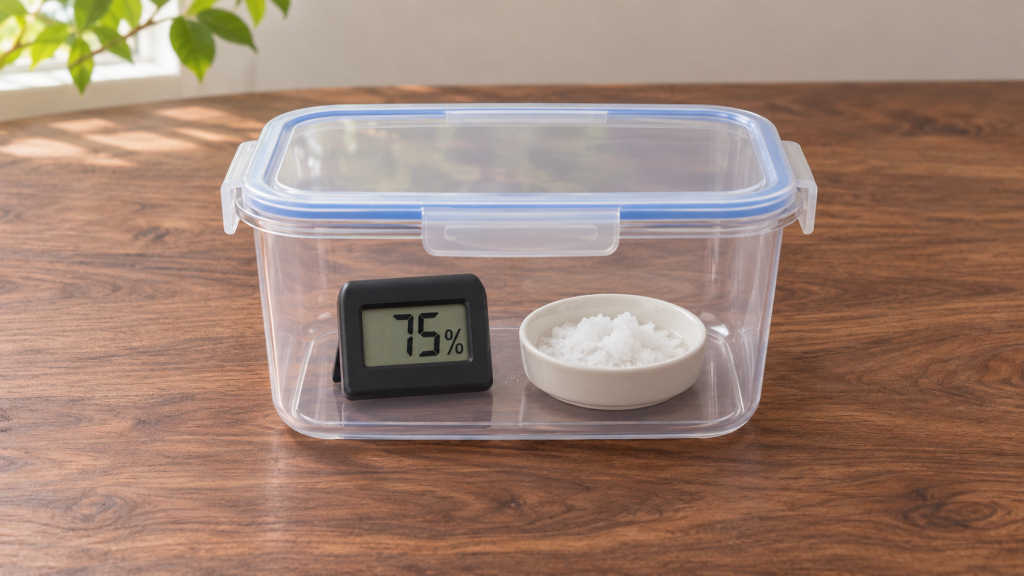
If the display says 62% and your humidity pack says 69%, which number do you trust? Start with a third number: the reading your hygrometer gives in a known reference environment. A hygrometer can be off by several points even when the display looks steady. Until you know how the gauge reads against a reference, changing the humidity in your humidor is guesswork.
Here’s how to calibrate a cigar hygrometer with a 75% relative humidity (RH) reference, what to do with a gauge you can’t adjust, and how to tell the difference between a bad reading and a humidor that needs attention. This guide is for adults 21 and older.
The quick answer
Put the hygrometer in a sealed calibration bag with a 75% RH reference and leave it at a stable room temperature for the time specified by the kit or gauge maker. Read it through the bag before opening it. If it reads 72% against a 75% reference, it reads three percentage points low at that test point. Adjust it following the owner’s manual or label it “add 3” and apply that correction when you check your humidor.
Doctor B’s rule: Verify the gauge before you change the box. The 75% reference is a test condition. Use your usual storage target when the gauge goes back into service.
Choose a calibration kit or a table-salt check
A sealed 75% calibration kit
A purpose-made kit is the simpler option if you want a repeatable check or have more than one gauge to compare. The reference comes prepared and the bag is designed for the job. Boveda’s calibration instructions call for at least 24 hours at 65–75°F with its kit. Follow the instructions for the particular reference you use. A pack marked 69% for everyday storage and a 75% calibration kit serve different purposes.
A homemade table-salt check
Ordinary table salt and a few drops of water can make a useful reference near 75% RH at room temperature when undissolved salt remains and the sealed air has time to stabilize. The Whynter humidor manual and Cigars International’s salt-test guide describe this approach. Home results depend on the seal, temperature, and preparation. If a one-point decision matters to you, use a purpose-made reference and check the gauge’s stated accuracy before drawing a conclusion.
How to do the hygrometer salt test
1. Prepare the reference and check the battery
For the homemade method, put a small amount of plain table salt in a clean, shallow cap. Add water a drop at a time until the salt looks like damp sand. You should still see salt crystals. If loose water pools or the salt completely dissolves, start again with fresh salt and less water. Keep the cap level. If your digital gauge has a low-battery indicator, replace the battery before testing and check whether your model retains its calibration after battery changes.
2. Seal the gauge beside the salt
Set the cap and hygrometer next to each other inside a clear resealable bag or a small airtight container. Keep salt and liquid away from the sensor and its vents. Face the display toward the clear side so you can read it without disturbing the test. Close the seal completely and set the container on an interior shelf or countertop where the temperature stays steady. A sunny windowsill, a heating vent, or the top of an appliance can change the conditions while you wait.
3. Let the reading settle, then record it
Published instructions for homemade tests vary. Leaving the test sealed overnight and checking again near 24 hours is a practical way to see whether the reading has leveled off. If the reading is still moving or the room temperature changed substantially, give the setup more time under stable conditions. Record the displayed RH, the temperature if available, the date, and the reference method. If the bag opened or the cap spilled, repeat the test before using the result.
4. Adjust the gauge or write down the correction
Subtract the displayed reading from the reference reading. A gauge that reads 72% against a 75% reference gets a +3 percentage-point correction. A gauge that reads 78% gets a −3 correction. A display of 67% in the humidor would therefore be approximately 70% with the first gauge and 64% with the second. Those estimates assume the gauge behaves similarly near your storage range. A single reference point does not establish accuracy across the entire scale.
If your digital gauge has a calibration mode, use the buttons specified in the manual. An adjustable analog dial may have a screw on the back. Use the adjustment method the maker specifies, then reseal the gauge and repeat the reference check. If there’s no adjustment, a small label on the back or a note in your phone works well. Apply the correction only once. If you already programmed +3 into the gauge, the displayed result has already been corrected.
What to check if the readings still disagree
Start with two gauges in the same place
A gauge against the lid and a second gauge beside the humidification source are sampling different spots. Check both with the same reference first. Then put them side by side in the closed humidor, away from direct contact with a pack or a damp surface, and let them settle. If they agree there but differ when returned to separate shelves, look at the locations and airflow before blaming either instrument. In a cabinet, take a reading near the cigars you want to monitor instead of assuming the display on the door represents every shelf.
Read the trend before changing humidification
Opening the lid exchanges air with the room. Temperature changes can move the relative humidity reading, too. Check at roughly the same time over a few days and read the display before you move cigars or swap packs. If a calibrated gauge keeps drifting downward, inspect the seal and check whether the humidification source is depleted or undersized. If you’re setting up an empty wooden box for the first time, see the step-by-step humidor seasoning guide before adding cigars.
Retest a gauge that behaves unpredictably
A consistent offset is easy to track. An offset that goes from two points low to six points high under the same stable conditions is harder to use. Check the seal and battery, then run the comparison again with a fresh reference. If the gauge still varies enough to change your storage decisions, replace it or compare it with another verified sensor. Leaving both sensors together during that test gives you a better comparison than checking two boxes on opposite sides of the room.
Frequently asked questions
How do I calibrate a digital cigar hygrometer without a calibration button?
Check it against a known reference and label it with the correction. If it consistently shows 73% in a 75% reference, add two points when you interpret the display. Repeat the reference check periodically and update the label if the result changes.
How often should I recalibrate a hygrometer?
Boveda recommends checking a new gauge and retesting about every six months. Also recheck after a battery change if the manufacturer says it resets the adjustment, after the gauge gets wet or takes a fall, or when readings start disagreeing enough to affect what you do with the humidor.
Is the wet-towel method as useful as the salt test?
A damp towel can show that the sensor responds to moisture. The actual RH around the gauge is harder to establish in that setup, and it tests near the upper end of the scale. A stable reference near 75% is more relevant for a cigar humidor. Check the manual first, especially before exposing a digital gauge to direct moisture.
Why does my 69% pack give me a lower reading?
The gauge, pack, and box all deserve a check. Verify the gauge independently, then consider how recently you opened the lid, whether the pack is still active, and how well the box seals. Give the readings time to settle after any change. The label on the pack is a useful target for its operation and the display tells you what is happening at the sensor’s location.
Give the gauge one evening on the bench
Set up the test tonight and write the result on the back of the gauge when it settles. Once you know how the display behaves, put the gauge back near your cigars and watch the trend for a few days. Then use the complete cigar storage guide to work through the rest of your setup, from the humidor seal to everyday humidity checks.